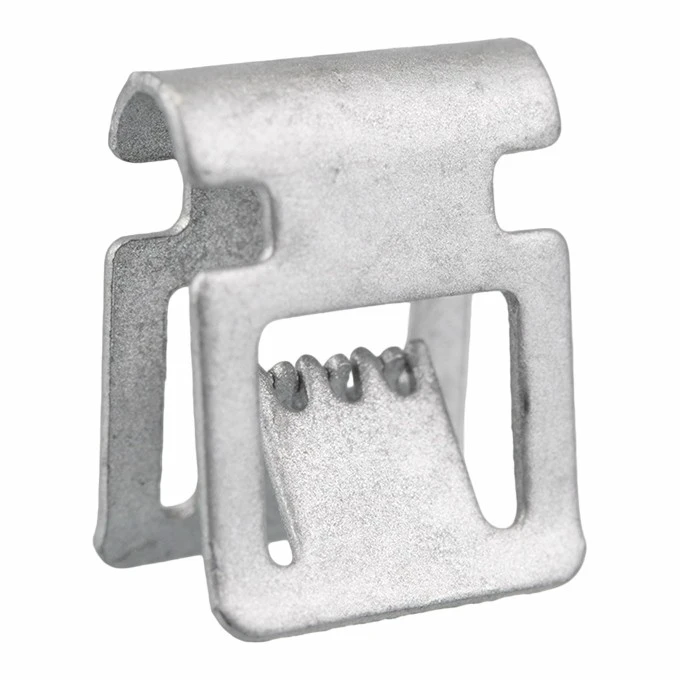
Standard Trim Clips are available in different configurations to match various panel thicknesses, mounting hole dimensions, and retention requirements. Key specifications include material options, clip size, leg design, insertion force, retention force, and surface finish. Common materials include carbon steel, stainless steel, and coated steel, with treatments such as zinc plating or Dacromet coating available for improved corrosion resistance. These components are widely used for secure panel mounting in automotive, machinery, and industrial assemblies.
| Parameter | Specification |
|---|---|
| Material | Spring Steel / Stainless Steel |
| Slot Length | Custom |
| Part Height | Custom |
| Rib Thickness | Custom |
| Slot Width | Custom |
| Setup Height | Custom |
| Design Variation | Standard / Custom |
| Surface Treatment | Zinc Plating / Dacromet / Custom |
Standard Trim Clips Design & Retention
Trim Clips use a spring-steel profile with a formed slot that engages with a rib, stud, or mounting feature. During installation, the clip flexes around the mounting feature and generates controlled contact force to maintain its position.
- Spring Retention: The formed legs provide elastic force against the mounting rib or stud.
- Slot Engagement: The slot captures the mounting feature and prevents the clip from moving out of position.
- Panel Support: The upper section provides a defined contact point for the panel or trim component.
- Vibration Resistance: Continuous spring contact helps maintain engagement when the assembly is exposed to vibration or repeated movement.

Standard Trim Clips Installation & Assembly Performance
Trim Clips are typically pushed onto a rib, stud, or formed mounting feature before the panel or trim component is installed.
Clip Positioning: Align the clip slot with the mounting rib or stud to ensure proper orientation before installation.
Push-On Installation: Press the clip onto the mounting feature until the retaining section is fully engaged and the clip is seated in position.
Panel Assembly: Position the panel over the installed clip and apply the required assembly force until the panel is fully seated without tilting or incomplete engagement.
Correct matching between the mounting rib and clip slot is essential for consistent installation and retention performance.
- Rib Thickness: Determines the required slot width and directly affects the clip's grip on the mounting feature.
- Slot Width: Should provide sufficient clearance for installation while maintaining effective spring contact after assembly.
- Slot Length: Determines the engagement area between the clip and mounting feature.
- Part & Setup Height: Controls the installed position of the clip and the resulting relationship between the mounting feature and panel.

Standard Trim Clips Manufacturer

As a Trim Clips manufacturer, we control tooling, stamping, forming, and dimensional inspection to produce consistent clip geometry for repeated assembly requirements.
- Precision Stamping: Controlled stamping processes produce consistent slot geometry, leg profiles, and overall dimensions.
- Tooling Development: Production tooling can be developed for different rib thicknesses, slot widths, and installation configurations.
- Dimensional Control: Critical dimensions such as slot width, slot length, part height, and thickness are monitored during production.
- Production Consistency: Standardized processes support stable quality across prototype, repeat, and high-volume production.
Standard Trim Clips Material Selection & Environmental Performance
Manufactured from spring steel or stainless steel, these components provide reliable mechanical strength, stable retention, and resistance to deformation during long-term use. The metal structure offers more consistent performance than plastic alternatives when exposed to continuous loads, vibration, and temperature changes.
To improve service life in demanding environments, surface treatments such as zinc plating, Dacromet, or electrophoretic coating can be applied. These finishes help protect against moisture, condensation, road salt, and other corrosion factors commonly found in automotive applications.
The elastic properties of the material allow the retaining sections to compress during installation and recover afterward, maintaining steady contact pressure and secure positioning throughout repeated operation.
Anhui Pins Production & Engineering Support
- Anhui Pins utilizes precision stamping and forming processes to maintain consistent dimensions, structural accuracy, and reliable performance across different fastening applications. Production control focuses on key factors such as component geometry, locking features, and mounting tolerances to ensure proper assembly compatibility.
- With in-house engineering support, customized solutions can be developed according to customer drawings, sample parts, panel thickness requirements, mounting specifications, and retention performance expectations. Tooling and production adjustments help achieve a precise fit for different assembly structures.
- Quality control procedures include dimensional inspection, surface treatment verification, and assembly testing to evaluate installation performance and ensure stable retention during use.
- From prototype development to large-volume production, Anhui Pins supports flexible manufacturing requirements for automotive components, industrial assemblies, and customized fastening applications.
FAQ
How do you ensure dimensional consistency during production?
Manufacturing processes are controlled through tooling accuracy, in-process inspections, and final verification. Critical dimensions are checked to ensure stable fit and consistent assembly performance across production batches.
Are these components suitable for automated assembly lines?
Yes. Their standardized structure and consistent forming accuracy make them suitable for efficient installation processes, including automated or semi-automated assembly operations.
What quality requirements can be supported for OEM projects?
Quality requirements can be managed according to customer specifications, including material verification, dimensional inspection, appearance checks, and functional testing before shipment.
What information should be provided when requesting a quotation?
Customers can provide drawings, samples, application details, expected quantities, and any special performance requirements. This information helps determine the appropriate design and manufacturing solution.
Hot Tags: standard trim clips, China standard trim clips manufacturers, suppliers, factory, automotive panel clip, High Strength Trim Clips, Metal Trim Clips, Standard Trim Clips, trim clips