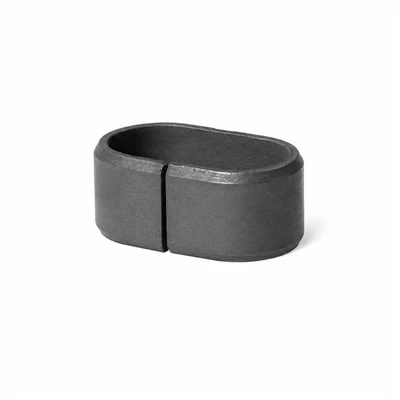

Stainless Steel Compression Limiter Specifications
| Parameter | Specification |
|---|---|
| Product Type | Stainless Steel Compression Limiter |
| Material | Stainless Steel |
| Design Types | AY / BY / CY / DY / EQ / FQ |
| Thread Size | M4–M12 |
| Outer Diameter (D) | According to selected type and size |
| Inner Diameter (d) | According to selected type and size |
| Length (L) | 4–30 mm |
| Wall Thickness (S) | 0.85–2.25 mm |
| Installation | Press-Fit / In-Mold |
| Application | Plastic, Rubber & Composite Assemblies |
| Customization | Diameter, Length, Wall Thickness & Material |

Dimensional Fit & Assembly
A compression limiter provides a defined metal load path through a joint when a bolt is tightened. Its length establishes a controlled stand-off between the clamped components, limiting how much the surrounding plastic, rubber, or composite material can be compressed.
- Defined Compression Limit
The limiter length determines the minimum compressed thickness around the fastener. When the bolt is tightened against the sleeve, further compression of the surrounding material is restricted.
- Metal-to-Metal Load Transfer
The clamping force is transferred through the metal sleeve rather than being carried entirely by the softer surrounding material. This helps reduce localized crushing around the bolt connection.
- Joint Dimensional Stability
Maintaining a defined sleeve length helps control the assembled height and compression condition of the joint, particularly where plastic or elastomer components are involved.
- Bolt Tightening Control
The required limiter length, bolt preload, surrounding material, and joint design should be considered together when establishing the appropriate tightening condition.
Compression Limiter Types & Geometry
Different configurations are available to accommodate variations in assembly geometry, installation method, and space around the fastener.
| Type | Geometry / Design Focus | Typical Consideration |
|---|---|---|
| AY | Standard cylindrical configuration | General compression limiting |
| BY | Precision configuration | Controlled dimensional fit |
| CY | Heavy-duty configuration | Higher clamping or structural requirements |
| DY | Oval configuration | Limited or directional installation space |
| EQ | Elliptical configuration | Non-circular assembly geometry |
| FQ | Round configuration | Specific mounting requirements |
The outer diameter, inner diameter, wall thickness, and length should be selected according to the bolt size, mounting hole, surrounding material, and required compressed height.
Metal Compression Limiter Installation Types

In-Mold Installation
The metal sleeve is positioned in the mold before the plastic or composite material is formed around it. This method integrates the limiter directly into the finished component.
Press-Fit Installation
The limiter is inserted into a prepared hole after the surrounding component has been formed. The outer diameter and mating-hole dimensions determine the required interference and retention condition.


Stainless Steel Compression Limiter Manufacturer
- Precision Metal Component Manufacturing
Anhui Pins specializes in small precision metal components, with production processes covering forming, sizing, cutting, and dimensional finishing for compression limiter applications.
- Dimensional & Process Control
Production focuses on critical dimensions such as inner diameter, outer diameter, length, and wall thickness. Process controls help maintain consistent geometry across batch production.
- Project-Based Production Capability
Anhui Pins supports standard and drawing-based requirements, including different configurations, stainless steel material specifications, dimensional tolerances, and installation conditions for plastic, rubber, and composite assemblies.
FAQ
How do I know if my plastic part needs a compression limiter?
A limiter is worth considering when a bolted joint passes through a plastic, rubber, or composite component that could be damaged or permanently deformed by the required fastener load. It is particularly relevant when maintaining a controlled clamping height is important.
How does the limiter affect the required bolt torque?
The sleeve establishes a physical compression limit, but the correct tightening torque still depends on the bolt size, thread condition, friction, joint materials, and required preload. Torque should therefore be established for the complete assembly rather than from the sleeve alone.
Can one compression limiter design be used for different plastic materials?
Not necessarily. Different plastics have different stiffness, creep behavior, molding shrinkage, and temperature response. A limiter dimension suitable for one material may require adjustment when the host component or its operating conditions change.
What happens if the limiter is too short?
A short limiter may allow excessive compression of the surrounding component before the sleeve carries the intended load. This can lead to deformation, dimensional change, or loss of the designed joint condition.
Can the same limiter be used for different bolt sizes?
The internal diameter must provide suitable clearance for the selected fastener, while the external geometry must fit the host component. A different bolt size may therefore require a different internal diameter or overall configuration.
Hot Tags: stainless steel compression limiter, China stainless steel compression limiter manufacturers, suppliers, factory, automotive mounting compression limiters, Brass Compression Limiter, custom compression limiters, Injection Molded Compression Limiter, Metal Compression Limiter, Precision Compression Limiter