
Technical Parameters
|
Parameter |
Normal Type |
Heavy Type |
|---|---|---|
|
Standard |
DIN 472:2017 |
DIN 472:2017 |
|
Product Type |
Internal Retaining Ring |
Internal Retaining Ring |
|
Design |
Normal Type |
Heavy Type |
|
Nominal Bore Size (d1) |
8–300 mm |
20–30 mm |
|
Ring Thickness (s) |
0.8–5.0 mm |
1.5 mm |
|
Free Outer Diameter (d3) |
8.7–315 mm |
21.5–32.1 mm |
|
Groove Diameter (d2) |
8.4–308 mm |
21.0–31.4 mm |
|
Groove Width (a max.) |
Varies by size |
2.0 mm |
|
Minimum Groove Dimension (d5) |
2.4–16.2 mm |
4.5–5.5 mm |
|
Hardness |
According to nominal size |
47–54 HRC |
|
Inspection Requirements |
Spiral Flatness, Hardness, Conical Deformation, Elasticity |
Spiral Flatness, Hardness, Conical Deformation, Elasticity |
|
Dimensional Unit |
mm |
mm |
Internal Circlip Installation & Groove Requirements
DIN 472 internal circlips are installed into machined grooves inside bores to provide axial retention for assembled components. The retaining ring must fit securely within the groove while maintaining sufficient contact with the retained component. Groove geometry and installation accuracy directly affect the ring's seating condition and load transfer.
Key Installation Requirements
- Bore Groove Machining: The groove diameter and width must correspond to the selected retaining ring size. Machining deviations can cause improper seating or excessive clearance.
- Groove Edge Distance: The distance between the groove and the component edge must comply with the applicable dimensional requirements to maintain sufficient supporting material around the groove.
- Contact Surface Condition: Burrs, sharp edges, and machining defects around the groove should be removed to prevent interference during installation and damage to the retaining ring.
- Ring Seating Verification: After installation, the ring should be checked around its circumference to confirm that it is fully seated in the groove rather than partially engaged.
- Assembly Clearance: The axial position of the retained component should be evaluated to prevent unnecessary impact or excessive movement against the retaining ring.
Axial Retention Performance & Load Requirements
The primary function of a DIN 472 internal circlip is to resist axial displacement of components positioned inside a housing or bore. When an external axial force acts on the retained component, the load is transferred through the contact surface to the circlip and then into the groove wall.
Factors Affecting Retention Performance
- Axial Load Direction: The retaining ring is designed to resist axial forces transferred through its contact with the retained component. The direction and distribution of the applied load should be considered during assembly design.
- Groove Supporting Strength: The load capacity of the complete connection depends not only on the retaining ring but also on the strength of the groove wall and surrounding housing material.
- Contact Area: The contact geometry between the retained component and the circlip affects how the axial force is distributed around the ring.
- Dynamic Loading: Applications involving repeated impact, vibration, or fluctuating axial forces require additional evaluation of fatigue, wear, and groove deformation.
- Assembly Deformation: Excessive installation expansion or compression may affect the ring's final seating condition and retention performance.

Manufacturing Process & Quality Inspection
Manufacturing DIN 472 internal circlips requires control over ring geometry, edge condition, elasticity, and dimensional consistency. Since the finished ring must expand during installation and return to its retaining position, dimensional inspection alone is insufficient to evaluate its functional condition.
Manufacturing Process
- Spring Steel Strip Preparation: Material is prepared according to the specified thickness and material requirements. Strip consistency provides the dimensional basis for subsequent forming operations.
- Ring Blanking: The retaining ring profile is produced according to the specified inner and outer contours, including the opening and installation features.
- Forming & Shape Control: Forming operations establish the ring's circular profile and free-state geometry. Distortion and uneven curvature need to be controlled.
- Heat Treatment: The ring undergoes the specified thermal processing to establish the required hardness and elastic behavior.
- Surface Finishing: Burr removal and specified surface protection are handled according to the product requirements.
DIN 472 Circlips Manufacturer
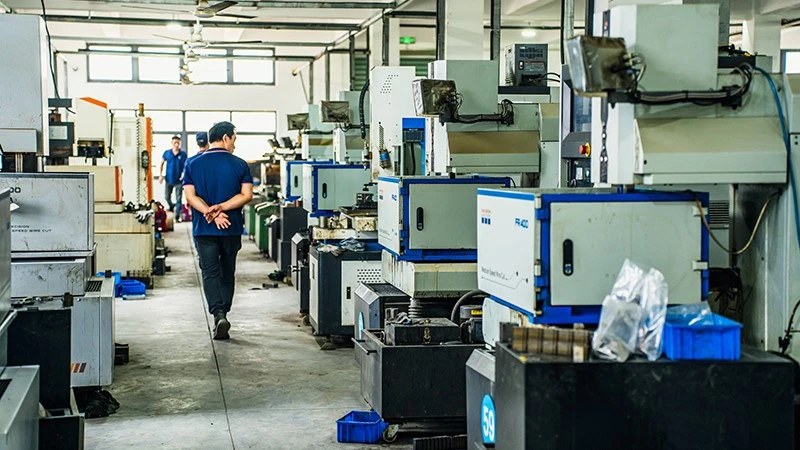
Anhui Pins Metal Products Co., Ltd. manufactures metal fastening components for industrial and automotive applications. Our production management combines process control, dimensional verification, and batch quality management to support consistent supply of retaining rings and other precision fastening products.
- Established Manufacturing Organization: More than 140 employees support production, technical coordination, quality management, and order fulfillment across the company's manufacturing operations.
- Automotive Quality Management: Certified to IATF 16949:2016, with process management focused on production consistency, inspection procedures, and quality documentation for automotive-related components.
- Production & Process Management: ERP-based management supports production planning, material tracking, order coordination, and manufacturing record management.
- Quality Testing & Verification: Quality control capabilities include dimensional measurement, optical measurement, tensile testing, and salt spray testing, supporting inspection requirements for metal fastening products.
FAQ
How can I identify whether an existing retaining ring is a DIN 472 circlip?
Check whether the ring is installed inside a bore rather than around an external shaft. Then measure its nominal bore size, ring thickness, free outer diameter, and other relevant dimensions. Compare these measurements with the DIN 472 dimensional tables. Visual identification alone may not be sufficient when distinguishing similar retaining ring standards.
What tools are required to install DIN 472 internal circlips?
Internal circlip pliers with inward-facing tips are generally used. The plier tips engage with the ring's installation holes and compress the ring sufficiently for insertion into the bore. The tool tip diameter and opening range should match the retaining ring size to avoid damaging the holes or deforming the ring.
Can a DIN 472 circlip be reused after removal?
Reuse depends on the ring's condition and the manufacturer's or equipment designer's requirements. A ring that has experienced excessive expansion, permanent deformation, cracks, or damaged installation holes should not be reused. For safety-critical assemblies, replacement with a new ring is generally recommended.
Are DIN 472 circlips supplied with installation holes?
DIN 472 internal retaining rings include installation features that allow suitable circlip pliers to engage with the ring. The hole geometry and dimensions depend on the specified ring size and standard design. Buyers should refer to the applicable dimensional drawing when selecting installation tools.
Hot Tags: din 472 circlip, China din 472 circlip manufacturers, suppliers, factory, bearing retaining rings, Bore Retaining Ring, Inner Circlip, internal circlips, internal circlips for housings, internal retaining ring retainers